
- Reuters, DUBLIN
EU leaders gathered in Dublin yesterday for their first ever summit on artificial intelligence (AI), to debate how the bloc can catch up with the US and China, and tackle funding issues and other problems.
The meeting comes amid mounting worries about a technology that promises to transform industries and societies, but over the past few months has caused alarm after a series of incidents involving rogue AI agents.
There was further turmoil this week with the resignation of Nvidia cofounder Jensen Huang (黃仁勳), leaving the industry without its biggest champion.
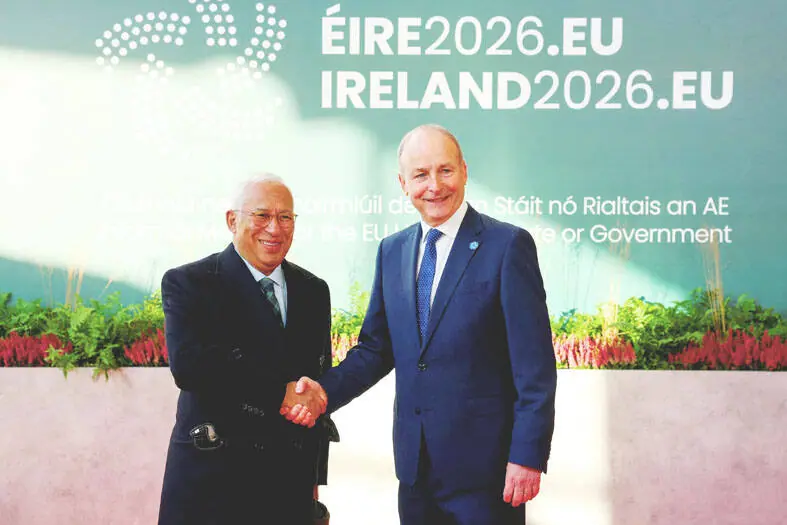
Irish Taoiseach Micheal Martin, right, welcomes European Council President Antonio Costa to an informal meeting focused on artificial intelligence in Dublin yesterday.Photo: Reuters
Leaders in Dublin were to also assess how to overcome other problems such as red tape and set guardrails.
“Given the rapid pace of AI development, I believe that a first dedicated discussion, at leaders’ level, is now needed on the opportunities presented by AI, as well as on its transformative effect on our economies and societies,” European Council President Antonio Costa wrote in an invitation letter to EU leaders last week.
Mistral AI CEO Arthur Mensch and Nobel Prize-winning AI pioneer Geoffrey Hinton were to brief EU leaders.
Europe will have to ramp up its efforts if it is to be an AI player. An initiative known as the Chips Act implemented three years ago looks likely to fall short of its goal to attract advanced manufacturing and double the bloc’s share of the global chip market to 20 percent by 2030.
A plan to build seven AI gigafactories to house advanced AI processors, software, cloud technology, high-speed connectivity and data centers under one roof has yet to fully take off due to the fight among EU countries over spending on competitiveness in the bloc’s 2028 to 2034 budget.