
- By Chiu Chun-fu and Fion Khan / Staff reporter, with staff writer
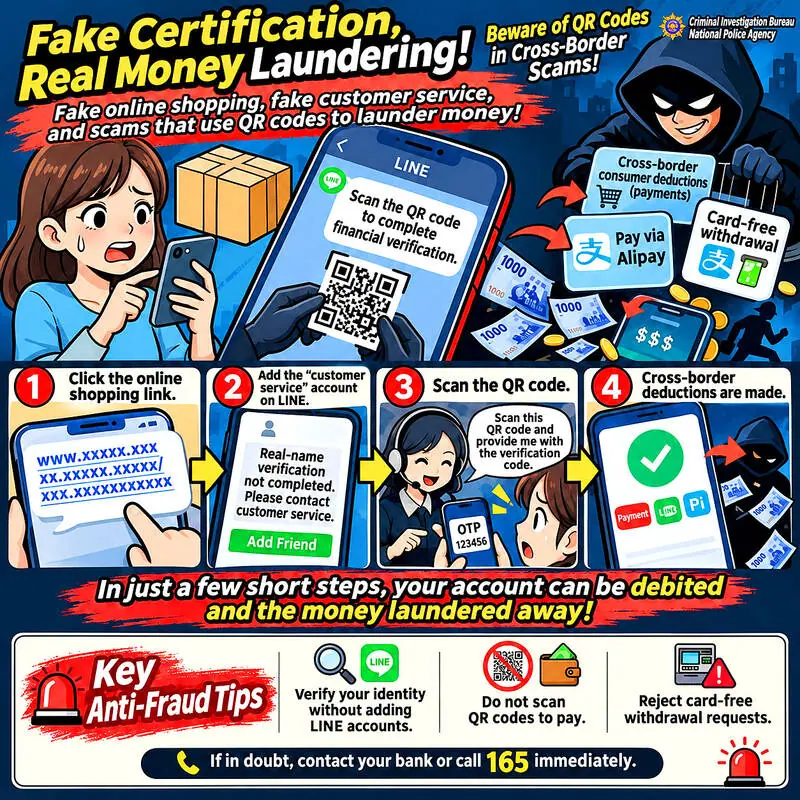
Fraud rings are combining fake online shopping with fraudulent customer service tactics to scam people, the Criminal Investigation Bureau (CIB) said, adding that victims who follow the instructions might find their bank accounts charged for overseas purchases or used for cross-border money laundering.
A woman surnamed Fan (范) in southern Taiwan was charged for five overseas transactions after falling victim to a scam, the CIB said.
Fan in June purchased a microwave oven through an advertisement in a Facebook group and was told that the transaction would be handled through a cash-on-delivery service, the bureau said.
An infographic warns against scams.Photo courtesy of the Criminal Investigation Bureau
After clicking the link and entering her information, she was told that real-name verification had not been completed and that she needed to contact online customer service, it said.
She was then directed to a fake customer service account on Line and was told that she needed to make a bank transfer online to complete the financial verification process, it said.
The scammer sent her payment QR codes generated on overseas e-commerce platforms, instructing her to scan them using her mobile banking and electronic payment applications under the guise of verification, it said.
After scanning the QR codes, she found two transactions appeared on her bank statement listed as “e-cross-border shopping,” and three additional overseas shopping charges listed as transactions using “Alipay” (支付寶), China’s third-party payments platform, it said.
Realizing she had been scammed, she reported the incident to a local police station, the bureau said.
Fraud groups exploit overseas online shopping platforms, such as Taobao, by posing as sellers and providing an overseas payment option, generating payment QR codes, it said.
They disguise the codes as verification codes and trick victims into making payments to obtain high-value goods or launder money overseas, it said, urging the public to be vigilant.