
- By Huang Ching-hsuan / Staff reporter
A five-tier audit system and “dark Web” monitoring tools are among the measures outlined as part of efforts to tighten cybersecurity following a series of data breaches in the past few weeks, the Ministry of Foreign Affairs (MOFA) said.
Last year, the ministry investigated reports that its electronic official documents were being offered for sale on the dark Web. Earlier this month, hackers also breached some of the Web sites of its Bureau of Consular Affairs, potentially affecting more than 72,000 passport photos, more than 26,000 scanned authorization letters and data from more than 700 APEC Business Travel Card applications.
In a report to the Legislative Yuan, the ministry outlined additional measures to shore up cybersecurity, including mandatory training for overseas diplomatic personnel and new recruits, regular security checks and inspections under a five-tier audit system, and the adoption of External Attack Surface Management (EASM) and dark Web monitoring tools.
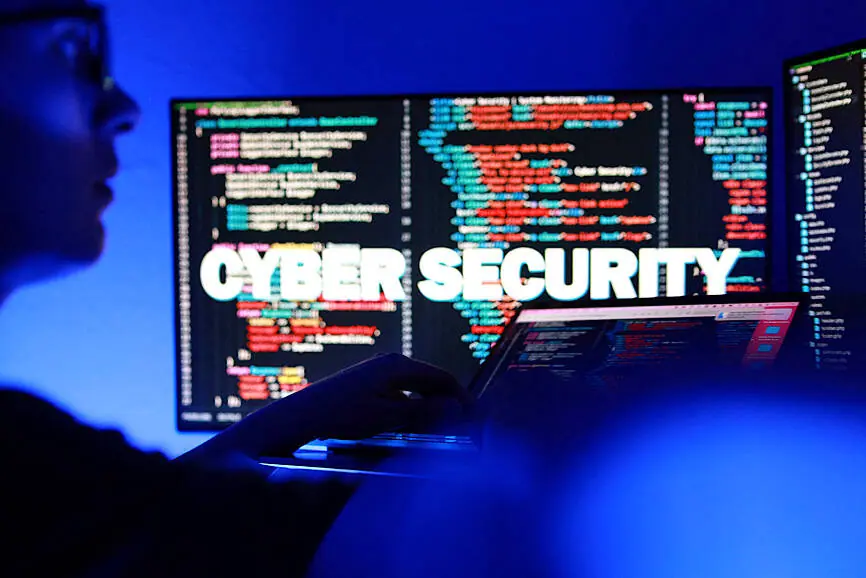
A person sits next to monitors with the words “Cyber Security” displayed over code on a screen in an illustration photograph taken on Oct. 22.Photo: Reuters
They also include dedicated multiprotocol label-switching connections between Taiwan and its overseas missions to enhance network connection security, a security operations center and an off-site backup mechanism to ensure the security of its information systems and data.
Regarding information asset management, the ministry said it implemented physical computer isolation, and that air-gapped computers are prohibited from connecting to the Internet, while Internet-connected devices are barred from storing classified documents and prohibited from connecting with air-gapped computers.
The ministry said it had deployed asset management software to bolster information equipment management and applied the Government Configuration Baseline to ensure computers comply with cybersecurity regulatory requirements.
It also conducts a comprehensive annual inventory of computer equipment, software, hardware, portable storage media, data and services, as well as thorough inspections for products that jeopardize national information and communication security, it said.
Usage regulations have also been established for ministry-issued information and communication equipment, it said, adding that inventory management and decommissioning or disposal procedures are implemented.
For example, decommissioned equipment must undergo physical destruction or magnetic data erasure to prevent the leakage of classified information, it said.
All computers used by overseas missions to send and receive unclassified electronic official documents must be solely dedicated to that purpose, it said.
Browsing the Internet or sending and receiving e-mails on them is prohibited to reduce information security risks, it added.
In accordance with the Cyber Security Management Act (資通安全管理法), the ministry also classifies information and communication systems according to their protection requirements, implements Web site anti-tampering mechanisms, conducts quarterly vulnerability scans on sites and network equipment, and regularly audits user account permissions to promptly delete or deactivate the accounts of departing or transferred personnel.
Aside from stepping up cybersecurity training for its personnel, overseas missions have adopted a five-tier audit system consisting of self-checks by users, checks by information security officers, audits by an interagency cybersecurity team and cybersecurity monitoring, it said.
An interagency cybersecurity audit team is jointly organized annually by MOFA, the Ministry of National Defense and the Administration for Cyber Security, it said.
Cybersecurity monitoring uses EASM and dark Web monitoring tools from MOFA, supplemented by round-the-clock monitoring and protection provided by professional cybersecurity vendors.