
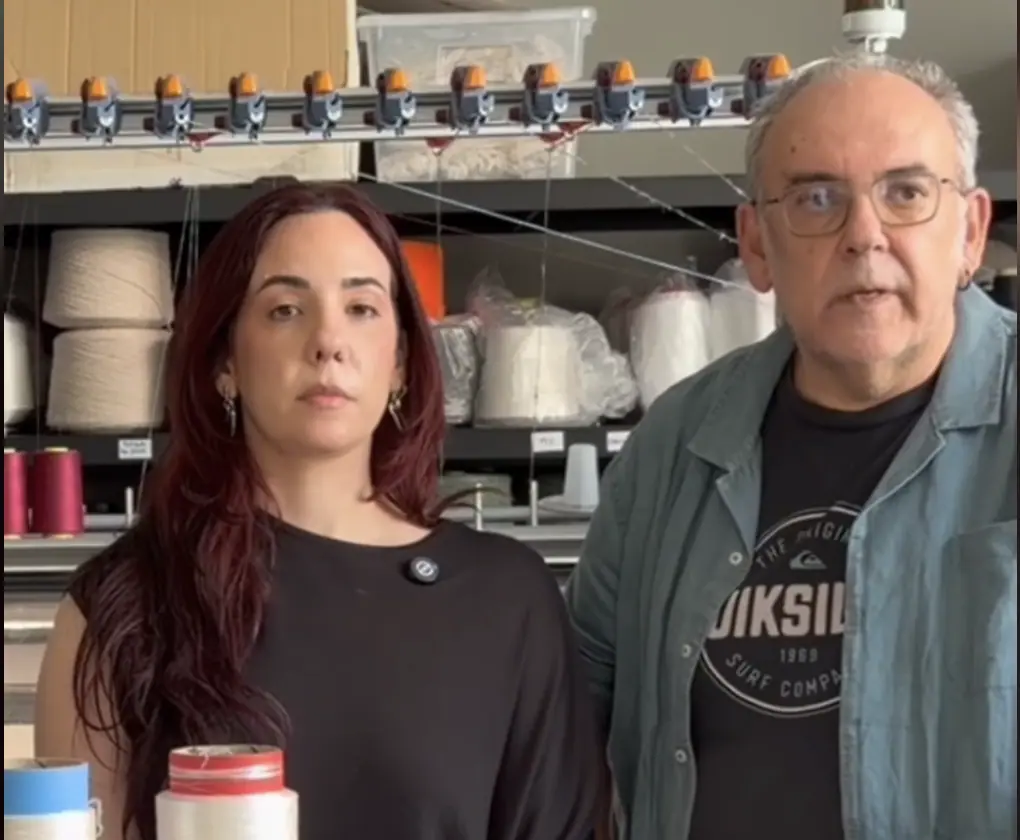
European Textile Network conference explores how digital knitting technologies are redefining traditional craftsmanship.
Athens Knit Lab’s Marianna Fasoi and Vasilios Fasois.
© Athens Knit Lab16th November 2026
Knitting Industry
| Athens, Greece
Can computer-controlled flat knitting machines be considered tools of craftsmanship, or does automation fundamentally change the nature of textile making? This question was at the centre of a presentation by Marianna Fasoi of Athens Knit Lab at the recent European Textile Network (ETN) conference in Athens, Greece.
Entitled Reimagining Traditional Textile Practices: From Craft to 3D Knitting, the presentation challenged conventional distinctions between traditional textile crafts and advanced manufacturing technologies, arguing that digitalisation does not eliminate craftsmanship but transforms how specialist knowledge and creativity are applied.
The European Textile Network brings together practitioners working across traditional textile disciplines, including weaving, hand knitting, tufting and embroidery. Its membership is predominantly European, with strong representation from Germany, making the conference an appropriate setting to examine the evolving relationship between established craft practices and contemporary textile production.
Athens Knit Lab, a specialist in advanced flat-bed machine knitting and its applications, was invited to contribute to the discussion, offering a perspective from a sector increasingly characterised by sophisticated computer programming, automated machinery and three-dimensional textile construction.
Marianna Fasoi questioned whether the use of automated machinery necessarily removes the human skills traditionally associated with craftsmanship. While modern knitting machines can execute programmed movements, repeat complex sequences with precision and expand manufacturing possibilities, they remain dependent on human expertise throughout the development process.
Tradition and technology should not be regarded as opposing forces
Design interpretation, programming, yarn selection, stitch construction, tension control and the management of material behaviour all require specialist knowledge. Equally important are troubleshooting, quality assessment and the continuous refinement of knitted structures to achieve the desired results.
As Marianna Fasoi explained in her presentation, automation does not remove expertise but relocates it.
This distinction is particularly relevant to advanced flat knitting, where the relationship between yarn properties, machine programming and stitch architecture determines the shape, texture and functionality of the finished textile.
Rather than operating as an autonomous production system, the knitting machine responds to decisions made by designers and technicians. Its capabilities depend on their understanding of materials, structures and the interaction between mechanical processes and textile behaviour.
The presentation drew parallels between traditional craft knowledge, developed through touch, tension and experience, and contemporary machine knitting, which combines these same principles with digital tools, programming and precision engineering.
In this context, technological development can be understood as an extension of established textile knowledge rather than a departure from it. The methods may change, but the underlying understanding of fibres, yarns and fabric construction remains essential.
Marianna Fasoi of Athens Knit Lab at the recent European Textile Network (ETN) conference in Athens, Greece.
© Athens Knit Lab
Fasoi also highlighted the potential for integrating traditional materials and contemporary knitting techniques through examples of Athens Knit Lab’s work. These included knitted bags incorporating leather components, demonstrating how engineered knitted structures can be combined with conventional materials to create distinctive products.
Such applications illustrate the opportunities offered by digital knitting technologies to develop new forms, textures and constructions while retaining the material sensitivity and design judgement associated with traditional craftsmanship.
The discussion also raises broader questions for textile education and manufacturing, particularly as digital design systems and increasingly sophisticated machinery become central to product development. Understanding how to operate these technologies is only one part of the process; interpreting material behaviour and translating creative ideas into workable knitted structures remain equally important.
For Marianna Fasoi, the future of craft is not necessarily less human. Instead, it involves a different relationship between the hand, the mind, the material and the machine.
Her central argument was that tradition and technology should not be regarded as opposing forces. Traditional practices provide the accumulated knowledge on which innovation depends, while contemporary machinery enables that knowledge to be expressed through new structures, applications and production methods.
The presentation concluded by questioning whether a process can truly be described as automated when a craftsperson may spend weeks understanding a material, developing a structure and refining a completely new product, even if the machine ultimately performs the knitting operations.
For the wider textile industry, the message is particularly relevant as advanced manufacturing increasingly blurs the boundaries between craft, design and industrial production. Rather than replacing craftsmanship, digital knitting may offer new ways for it to evolve.
The challenge, Marianna Fasoi suggested, is not to choose between traditional textile practices and technological innovation, but to recognise the possibilities created when the two are integrated.