Autonomous agents are already moving markets — executing trades, managing risk, and negotiating transactions at a speed and scale no human team can match. Institutions that treat this as a distant disruption risk falling behind those already adapting.
CNBC's Digital Finance Forum, being held today in New York City, is bringing together the decision makers who are building the next layer of global finance to discuss the protocols enabling autonomous value exchange, the regulatory frameworks struggling to keep pace, and the strategic decisions Wall Street can no longer defer.
6 Min AgoHow Franklin Templeton is integrating AI into financial services
Cheng Xin | Getty ImagesThere is a lot of talk about how AI and agentic technology are already impacting bottom lines.
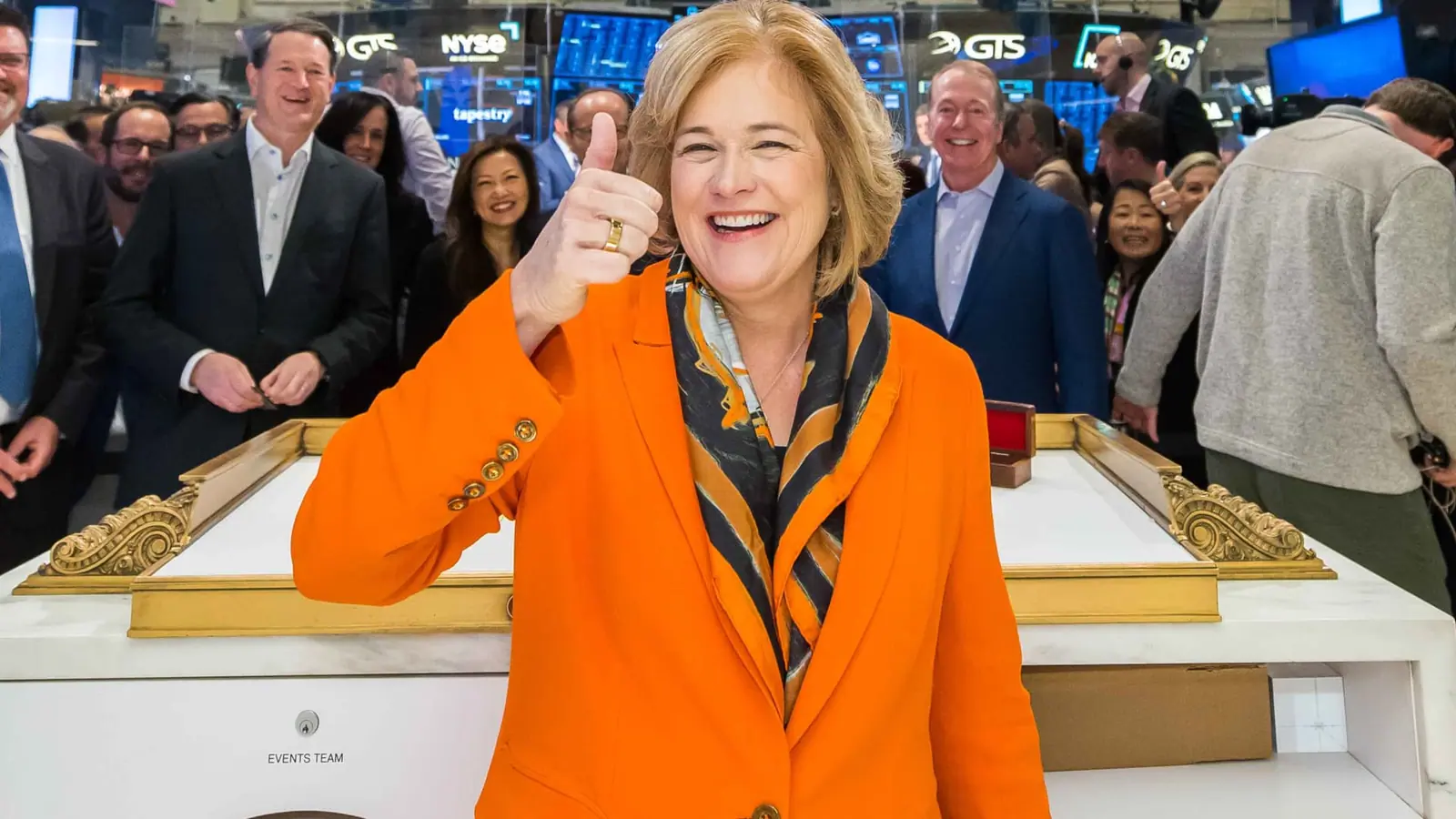
However, from Franklin Templeton CEO Jenny Johnson's perspective, "Today there isn't an industry that has yet materially leveraged AI to actually change their earnings, other than the picks and shovels side."
But Johnson told CNBC's Leslie Picker at the Digital Finance Forum that her firm has several AI projects that "are in the pipeline" moving towards that goal.
The furthest along, she said, is around what she called "distribution," or making sure that salespeople are having the right conversations with clients.
Franklin Templeton created an AI-powered intelligence hub, a platform it created in collaboration with Microsoft. The hub brings together data sources, research and workflow tools for sales professionals, while also using AI to automate list generation and prep them for meetings, ultimately giving them more time to focus on the client than administrative tasks.
Johnson said that when clients go through the hub, there is a 47% increase in sales. The salespeople who are using it are seeing their clients increase by 23%, she said.
On the investment side, Johnson said that the firm has more than 1,000 agents supporting those teams, which she said is "turning analysts and others from just being information gatherers to being much more analytic to apply judgment."
"You can have these agents build a model on a company that used to take a week to do in Excel," she said.
The firm also has a new proprietary AI tool it calls Gromit, which Johnson said is a "participant in our multi-asset investment committee."
Gromit parses through 57 data sources to independently analyze topics, which could then be used to support opinions or offer contrarian takes.
"It'll ask questions. It'll give prompts of ideas to invest," Johnson said. "It doesn't act on its own, but it acts like a member of an investment committee."
Johnson said some of the firm's AI efforts may not work or be effective in that move toward impacting the bottom line.
However, she said, "I think we're all going to have to learn about that part of it."
— Ian Thomas
1 Hour AgoDemocratic sweep likely to usher in stricter era for crypto
U.S. Capitol Building in Washington, D.C.Getty ImagesThe new balance of power in Congress will likely usher in a more adversarial era toward crypto in Washington, as Democrats have historically been less supportive of crypto than Republicans.
Analysts say with Democrats in control of both the House and Senate, Congress is likely to focus on scrutinizing President Donald Trump's personal dealings with crypto over supportive industry legislation, CNBC's Tanaya Macheel reported.
With crypto critics like Sherrod Brown, D-Ohio, returning to the Senate and Sen. Elizabeth Warren, D-Mass., retaining significant influence over financial policy, analysts say it's unlikely that industry-friendly legislation like the Clarity Act will move forward.
"We see Sherrod Brown winning in Ohio as damaging the crypto industry's political clout as the industry worked to defeat him," Jaret Seiberg, TD Cowen's Washington analyst, said in a note Wednesday. "We did not think Clarity could advance over the next two years. This makes us more confident in our prediction."
Seiberg emphasized that Democrats "will investigate Trump's crypto entanglements including World Liberty Financial" and said "the resulting political environment may make it impossible to advance a version of Clarity that the crypto sector could back."
For years, crypto often landed on the receiving end of regulation by enforcement, but after Trump took the presidency in 2024, the industry found a more receptive audience in Washington.
Ahead of the midterms, the crypto industry spent more than $200 million in hopes of electing leaders who could push through a comprehensive crypto market structure bill after the Clarity Act stalled in the Senate.
Mike Townsend, Charles Schwab's managing director of legislative and regulatory affairs, said he now expects "Democrats to push next year for a version of the bill that is much tougher on cryptocurrency companies."
The stakes extend other priorities for the crypto industry, including stablecoin innovation, decentralized finance development and tokenization.
That all said, the divide between the two parties has narrowed as more Democrats embrace the industry, and crypto has reached a level financial integration that could be difficult to reverse.
"We expect the Clarity Act to remain on hold through 2028. Even so, there is a clear path forward for stablecoins … and for the tokenization of public equities under the SEC's five-year innovation exemption," Joseph Chalom, CEO of ether treasury company Sharplink said. "Technological progress is rarely rolled back."
— Colleen McKown
1 Hour AgoRamp CEO Eric Glyman on how to build a financial operating system for the AI era
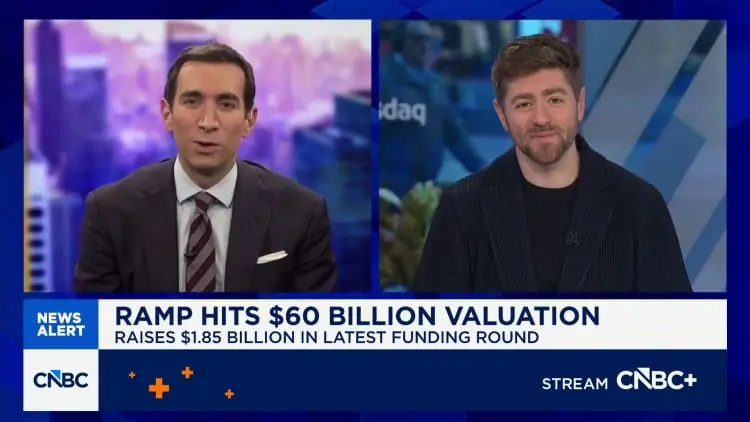
watch nowVIDEO5:5205:52Ramp's Eric Glyman on hitting $60B valuation: We offer customers an increasingly valuable productSquawk BoxCompanies of all shapes and sizes are trying to figure out how to manage artificial intelligence spending. That's where payment software giant Ramp is looking to get involved.
Ramp, which has been named to CNBC's Disruptor 50 list three times, has become one of the biggest firms in the competitive expense management space, handling credit cards, expense tracking and accounting for more than 50,000 companies.
That growth has helped the company's valuation skyrocket. It has raised funds twice this year, and according to the Wall Street Journal, is in early discussions with investors another round this year that would value it at more than $70 billion.
In October, Ramp announced a $1.85 billion primary financing round led by Dragoneer Investment Group, valuing the company at $60 billion. In the same announcement, the company said that it had surpassed $2 billion in annualized revenue, and that its revenue was growing 25% faster than it was at the same time in 2025.
CEO Eric Glyman credited some of that growth to helping companies deal with AI cost management, saying in a press release that "AI opens up much more of the work it takes to run a company. Our opportunity is to get that work done at less cost. We want to help every business run better with AI."
— Ian Thomas
1 Hour AgoCFTC chair says crypto industry is embracing agency rules
watch nowVIDEO16:2416:24CFTC Chair Michael Selig says the crypto industry is embracing the agency's rulemakingCryptoCommodity Futures Trading Commission Chairman Michael Selig is seeing interest from major crypto exchanges in using its newly proposed rules governing digital assets, CNBC's Talia Kaplan reported last week.
In October, the CFTC proposed rules aimed at preventing abuse in crypto markets and codifying crypto transaction rules under a federal rulebook.
Speaking this week at Cantor Convergence, an annual FinTech conference held in Miami Beach, Selig told CNBC in an exclusive interview that many of the major crypto exchanges are already registered with the CFTC because they offer financial derivatives, including perpetual futures, on their platforms and would now be able to add spot trading.
"We're also getting interest from new entrants who say, 'Look, signing up with 50 different state regimes is tough. We'd rather come to one regulator and get a license at the CFTC,'" he said.
After the Clarity Act, a comprehensive market structure bill that established a regulatory framework for digital assets, stalled in the Senate in September, the CFTC and the SEC moved to establish federal frameworks using their existing statutory authorities.
"We need to protect our markets and protect our customers using those markets so we'll continue to do exactly that in the wake of the Clarity Act failing to get the votes it needed to get to the president's desk during the current Congress," Selig said.
But the CFTC's new rules could face increased scrutiny in 2027 when Democrats take control of both houses of Congress. Selig told CNBC he hopes the U.S. won't see a wave of software developers moving offshore, as many crypto businesses threatened to do under the Biden administration.
"I do hope that we can work together with both sides of the aisle to protect software developers who want to do the right thing," Selig said, adding that those looking to commit crimes and engage in fraud should be held accountable.
— Colleen McKown
1 Hour AgoFranklin Templeton CEO Jenny Johnson on how the firm is preparing for agentic AI
watch nowVIDEO5:1405:14Real productivity gains from AI are yet to come, says Franklin TempletonAccess Middle EastThe old rules of investing are being rewritten, but Franklin Templeton, one of the largest global investment managers, is signaling that it's not waiting for the future to arrive without evolving first.
Despite recent price suppression of cryptocurrencies, institutional appetite has continued to grow. In general, firms have favored yield and sophisticated active strategies as passive crypto products mature.
Franklin Templeton has strong roots in active investing and has become one of the more progressive legacy finance firms when it comes to crypto. Its footprint in digital assets spans crypto ETFs, traditional funds tokenized on public blockchains and partnerships with major crypto industry players.
Earlier this year, the firm agreed to buy 250 Digital, a small crypto investment firm, to further deepen its digital assets push. It had previously established the Franklin Crypto unit, and the new acquisition intended to increase its actively managed crypto investment offerings for its institutional clients beyond basic exposure through products like its bitcoin ETFs.
Franklin was among the issuers of the first batch of U.S.-listed bitcoin ETFs in 2024. It has more than $1.81 trillion of assets under management.
So how is the nearly 80-year-old firm preparing for a new agentic AI era? CEO Jenny Johnson will be sitting down with CNBC's Leslie Picker at CNBC's Digital Finance Forum Tuesday to discuss what comes next. —
— Ian Thomas
1 Hour AgoWho is speaking at CNBC's Digital Finance Forum
Digital generated image of multiple white cubes with abstract economy graphs and charts. Fintech concept.Andriy Onufriyenko | Moment | Getty ImagesAI and blockchain technology are converging to fundamentally reshape the way that money moves, businesses operate, and markets function.
CNBC is bringing together an lineup of financial leaders, tech innovators, and investors to share how they are collaborating to make financial services more accessible and efficient.
Those speakers include:
- Franklin Templeton CEO Jenny Johnson on positioning her firm for the age of agentic AI.
- Fundstrat Co-founder & Head of Research Tom Lee, and Pantera Capital Founder & Managing Partner Dan Morehead discuss how to build an entirely new financial system for the agentic economy.
- Bullish CEO Tom Farley, and SkyBridge Capital Founder & Managing Partner Anthony Scaramucci on the implications of AI starting to transact on its own.
- Ramp Co-founder & CEO Eric Glyman on how the finance function is evolving amid AI.
- MetaMask CEO Joseph Lubin to discuss Ethereum's evolution from bold experiment to global infrastructure.
— Ian Thomas