
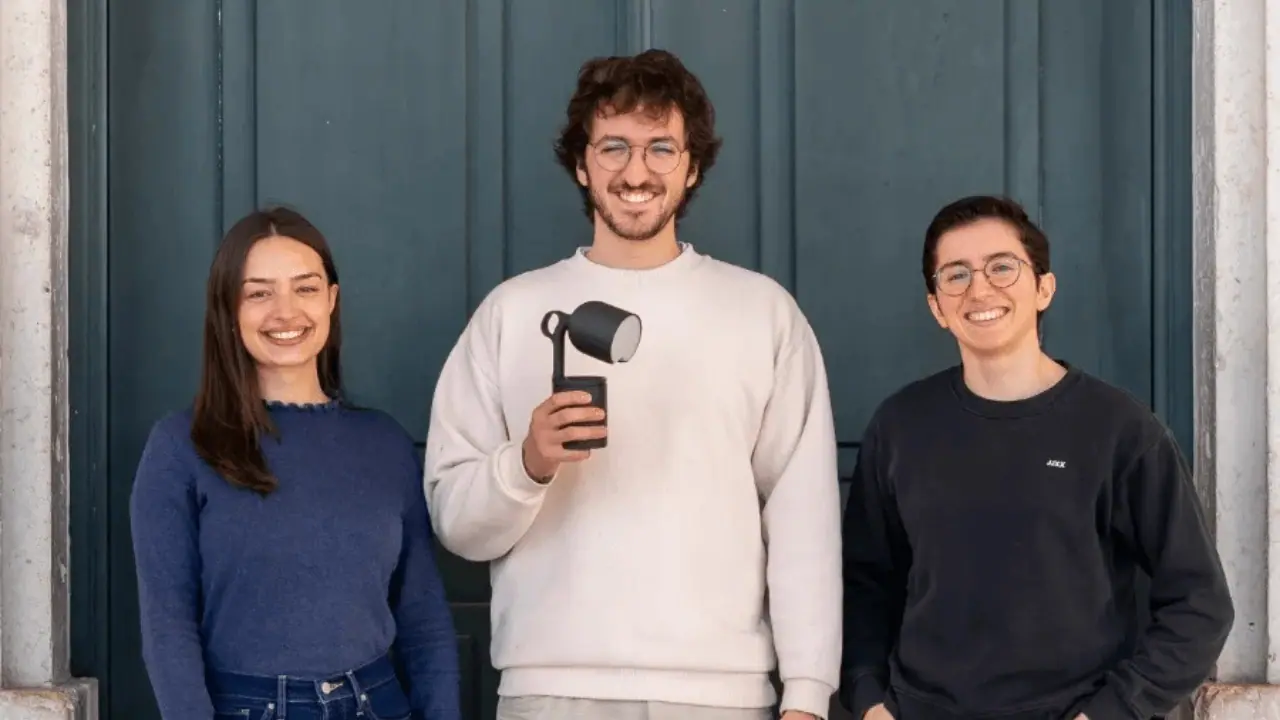
Lampsy Health has closed a €1.1 million funding round to finance the commercial launch and distribution of its product in Europe and the UK. The Portuguese startup has developed a lamp that monitors for epileptic seizures during sleep.
The smart lamp is embedded with a small built-in camera and a proprietary artificial intelligence algorithm. It detects movements that may indicate a seizure with over 97 per cent accuracy and automatically alerts emergency contacts.
Fundação Ageas and Portugal Ventures led the round, with participation from Angels Way, Phira Ventures and strategic business angels with experience in medicine, logistics, marketing and consumer experience, including Edward Tomordy, Izi Mizrahi, João Miguel Maia, Susana de Sousa, Ellie Asgari, Peter Kirkham, Toy Ogunkua, Jona Stark and Gesa Reuter. The total also includes financial support from the EU through the European Innovation Council's Pre-Accelerator programme.
Most night-time seizures go unnoticed
The problem Lampsy Health is tackling is a big one. One in five people will, at some point in their lives, have a close relative with epilepsy. For thousands of families, this means living with the constant fear that a seizure could happen at any moment while no one is there to help, since 86 per cent of night-time seizures go unnoticed.
Someone sleeping in the next room may notice nothing. Most existing solutions rely on body-worn sensors, which are uncomfortable during sleep and visible to people living with a condition that still carries stigma. The WHO recognises that the stigma and discrimination surrounding epilepsy can often be as hard to overcome as the seizures themselves.
Lampsy was designed with these families in mind. It uses no body-worn sensors, adds no extra steps to the daily routine, and doesn't look like a typical medical device. It looks like a bedside lamp. Inside, a small camera with infrared lighting tracks movement during sleep, even in the dark.
A computer vision and AI system running on the device itself recognises the patterns associated with tonic-clonic seizures. When one is detected, Lampsy automatically calls the contacts chosen by the user and sends an alert to the app.
The World Health Organisation (WHO) estimates that around 50 million people worldwide live with epilepsy. They face up to three times the risk of premature death of the general population, and one in three continues to have seizures despite regular medication. In Europe alone, 300.000 new cases are diagnosed each year, and it has been shown the SUDEP (Sudden Unexpected Death in Epilepsy) is responsible for 33,000 deaths/year, of which 40 per cent are preventable.
Vicente Mayer Garção, co-founder and CEO of Lampsy Health, says:
"This project began with a request from a medical team at Hospital de Santa Maria: to find out what happens to these patients at night without forcing them to sleep hooked up to a machine.
Bringing that answer into families' homes is the step that gives meaning to all the work we've done in the lab and in hospitals."
Until now, the smart lamp has only been available to medical teams, through a partnership programme with all the public hospitals in the Lisbon Metropolitan Area that monitor epilepsy.
The tech has been tested on more than 9,200 hours of hospital data and has received European Union medical device certification. This will allow it to enter the market in the first quarter of 2027, serving a waiting list of more than 7,500 people across 20 countries.
According to Mayer Garção, half of the people on the company's waiting list are in the UK.
“Demand came before we did. This round gives us the means to respond, starting with the countries where families are waiting."
Lampsy's next step is to reach the families already waiting in Europe and the UK and, in the medium term, the United States. But the vision goes further: the Portuguese startup aims to become a reference in at-home chronic disease monitoring, using technology that is invisible, discreet and contactless.
Epilepsy is just the beginning, as the same technology could help monitor other conditions, such as sleep apnoea, which affects almost one billion adults worldwide today.
Over the past year, Lampsy Health has won a string of awards in Portugal and abroad. It won Startup World Cup Portugal 2026, earning the right to represent Portugal at the world final in San Francisco, and the KPMG Global Tech Innovator Portugal 2026, which took it to the international final at Web Summit in Lisbon.
Lampsy Health also won the Startup Showcase at WIRED Health 2026 in London and the Epilepsy Foundation's 2025 Startup Accelerator in the United States, and was named among WIRED's 100 most promising startups in Europe for 2026. It received an honourable mention in the Health and Wellness Design category of Fast Company's Innovation by Design Awards 2026, and was named Most Promising Startup 2025 by Unicorn Factory Lisbon.
The European Innovation Council selected it for the EIC Pre-Accelerator: it was one of 70 companies chosen from more than 1,000 applications in the programme's first call for deep-tech startups. Co-founders Vicente Garção and Leonor Pereira are also on the Forbes 30 Under 30 Portugal 2026 list.
Write Comment