
HELPING HAND: Chinese company Wayon Electrics Co paid the salaries of employees and the rented office space, with staff reporting back via WeChat
- Staff writer, with CNA
A woman was indicted yesterday for allegedly establishing a company in Taiwan without government approval to help a Chinese electronics firm expand its business and recruit high-tech workers, Taipei prosecutors said.
Prosecutors are seeking a prison sentence of at least 16 months for the woman, surnamed Yang (楊).
The Taipei District Prosecutors’ Office said it had concluded its investigation and indicted Yang and her company, Kinxi, for contravening the Act Governing Relations Between the People of the Taiwan Area and the Mainland Area (臺灣地區與大陸地區人民關係條例).
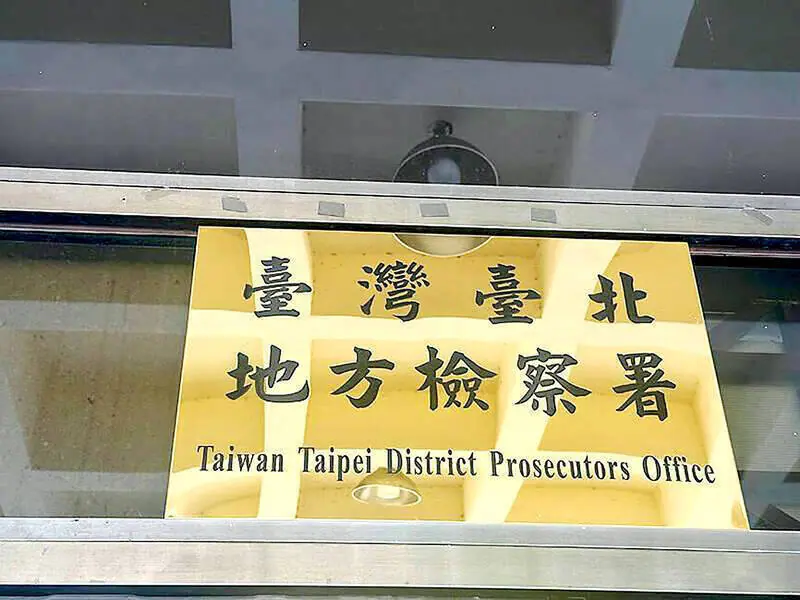
A sign at the main entrance of the Taipei District Prosecutors’ Office is pictured in an undated photograph.Photo: Wu Sheng-ju, Taipei Times
Prosecutors asked the court to order the forfeiture of US$48,000 in alleged criminal proceeds received by Yang.
Shanghai-based Wayon Electronics Co researches, develops, manufactures and sells electronic circuit protection components, discrete semiconductor devices and analog integrated circuits.
Yang, who had been hired by Wayon, allegedly helped establish a company called Kinxi in April last year without approval from the Ministry of Economic Affairs’ Administration of Commerce and served as its person in charge, prosecutors said.
She allegedly hired sales staff and rented office space to conduct marketing, develop Wayon’s business in Taiwan, negotiate prices with customers in Taiwan, and track project progress and orders.
She and Kinxi employees allegedly reported the company’s business activities in Taiwan to Wayon through WeChat, while Wayon covered their salaries and office rental expenses, prosecutors said.
Prosecutors said that Yang allegedly helped Wayon establish unauthorized operations in Taiwan, circumventing government oversight and enabling it to recruit workers from Taiwan’s technology sector.
They also alleged that she helped the Chinese company develop, manufacture and sell semiconductor-related products, harming Taiwan’s economy.
Prosecutors said that a lenient sentence would fail to safeguard Taiwan’s industrial development and technological achievements and would seriously undermine national security.