
- Staff writer, with CNA
Recent Chinese naval activity beyond the First Island Chain reflects the Chinese People’s Liberation Army’s (PLA) ability to conduct coordinated operations across the western Pacific and signals Beijing’s strategic ambitions, analysts said yesterday.
The assessment follows reports of Chinese naval movements stretching from southern Japan to Taiwan and the Philippines, reported separately by National Security Council Secretary-General Joseph Wu (吳釗燮) and by Japan’s Joint Staff Office.
Lin Ying-yu (林穎佑), an associate professor at Tamkang University’s Graduate Institute of International Affairs and Strategic Studies, said the PLA had integrated naval forces from its northern, eastern and southern theater commands.
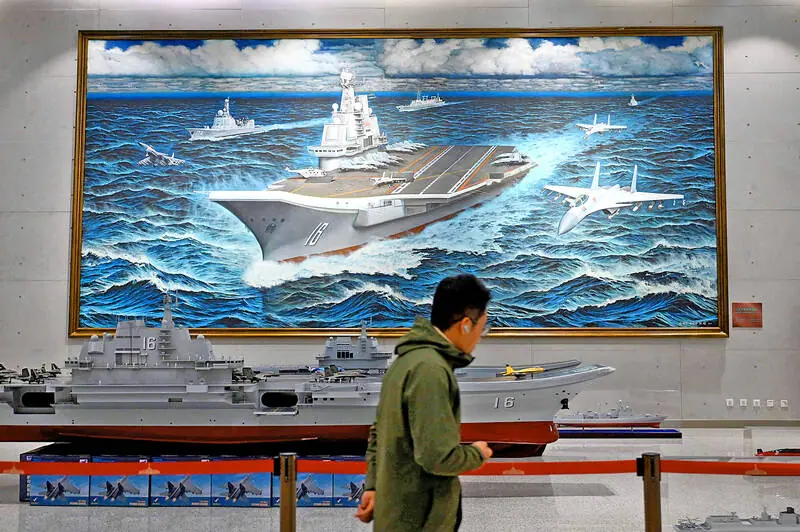
A man walks past a model and painting of the Chinese aircraft carrier Liaoning at the Military Museum in Beijing on March 3, 2024.Photo: AFP
Its naval operations should be viewed not as separate activities by individual theater commands, but as part of a broader “First Island Chain theater,” with interconnected vessel movements reflecting an overall operational plan for the First Island Chain, he said.
Citing information from Japan’s Joint Staff Office, Lin said the Liaoning aircraft carrier strike group passed through the Miyako Strait and sailed east of Taiwan toward the Philippine Sea.
The movement indicated that China’s focus remained on the South China Sea, where Beijing was using a form of “gunboat diplomacy” to pressure Manila, Lin said.
Lin said the attention on China’s aircraft carrier should not overshadow other advanced warships, particularly the Type 055 guided-missile destroyer seen in the operation, which he described as a measure of the Chinese navy’s combat strength.
Shu Hsiao-huang (舒孝煌), an associate research fellow at the Institute for National Defense and Security Research, said that PLA Navy activity had three political implications.
The activity was a response to the US-Japan Keen Sword 27 exercise, held on Monday last week to yesterday on Japan’s southwestern islands, and to a Wednesday meeting in Cebu between US Secretary of Defense Pete Hegseth and Japanese Minister of Defense Shinjiro Koizumi, Shu said.
The two officials agreed to strengthen defense cooperation along the First Island Chain linking Japan, Taiwan and the Philippines, he said.
Shu added that the naval activity was also a response to a US Army guide calling for regional forces to mobilize on the first day of an Indo-Pacific conflict and identifying China as a “pacing threat.”
On the military front, Shu said the Liaoning aircraft carrier is deployed at sea annually, but the scale of China’s naval forces involved this time was significant.
He said China was using routine exercises to build its ability to operate beyond the First Island Chain and gradually develop carrier strike group capabilities modeled on the US Navy.