
- Staff writer, with CNA
The government is considering legislation to penalize people who engage in transnational repression, Cabinet spokeswoman Michelle Lee (李慧芝) said yesterday.
Lee said the Cabinet was considering amendments to the Anti-Infiltration Act (反滲透法) to establish penalties for people who engage in transnational repression on behalf of an “external hostile force.”
Actions that could constitute offenses under the proposed amendments include surveillance, harassment and intimidation, Lee said.
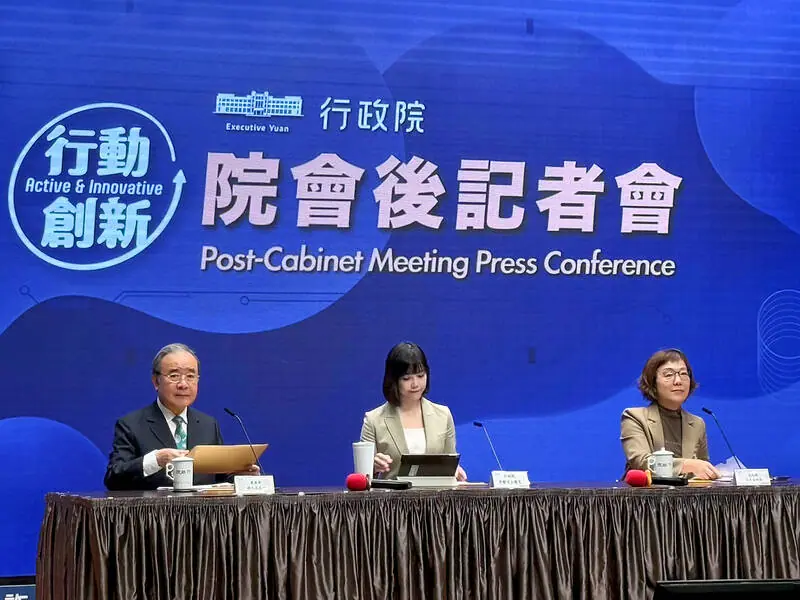
Cabinet spokeswoman Michelle Lee, center, presides over a post-meeting news conference in Taipei yesterday.Photo: Chung Li-hua, Taipei Times
“We will use clearer, more specific rules to protect public safety in the future,” Lee said.
“Once the required legal procedures are complete, we will submit the draft amendments to the Legislative Yuan as soon as possible. We hope the Legislative Yuan will review them promptly,” she added.
Lee made the remarks at a weekly post-Cabinet meeting news conference when asked how the government would respond to attempts backed by the Chinese government to pressure Taiwanese into making political statements.
The question followed an apology posted by entertainer Kevin Tsai (蔡康永) on Sina Weibo and Xiaohongshu (RedNote, 小紅書) after he appeared at an event marking the opening of the campaign headquarters for Democratic Progressive Party (DPP) and Taipei mayoral candidate Legislator Puma Shen (沈伯洋).
Shen, an expert on China’s cognitive warfare and disinformation campaigns, is among 14 people — most of them affiliated with the DPP — whom the Chinese Communist Party has designated as “die-hard Taiwanese independence separatists.”
“I have always hoped that the two sides of the [Taiwan] Strait can interact amicably. I have never supported Taiwanese independence,” Tsai wrote.
Tsai also apologized to business partners and fans he might have disappointed.
Many in Taiwan interpreted Tsai’s posts as an apology made under pressure from China.
Tsai has not commented on whether he made the posts under duress.
The incident drew comparisons to a similar case in 2016, when Taiwanese K-pop idol Chou Tzu-yu (周子瑜) of Twice issued a recorded apology after briefly waving Taiwanese and South Korean flags on a South Korean television show.
In the video, Chou said she was “proud to be Chinese.”