
- By Kao Chia-ho / Staff reporter
Taipei continued to see an outflow of residents as more people move to newer urban areas, with Shilin District (士林) recording the steepest population decline in the country, the Ministry of the Interior’s (MOI) latest data showed.
New Taipei City’s Tamsui District (淡水) led the nation in population growth, adding 3,103 registered residents over the past year and 45,092 over the past decade, the data showed.
By contrast, Shilin District lost 3,113 residents in the past year and 34,504 over the past decade, it showed.
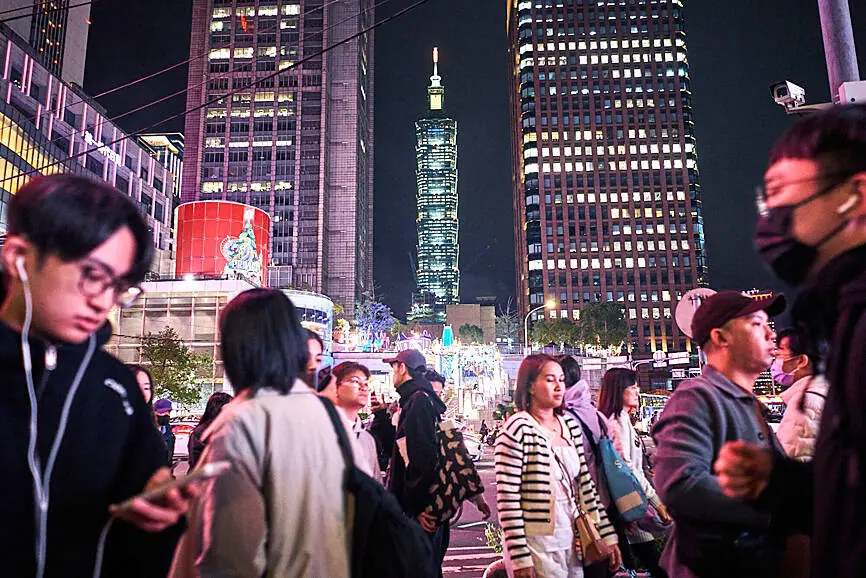
Pedestrians cross a road in front of Taipei 101 on Wednesday.Photo: An Rong Xu, Bloomberg
The districts with the highest population growth after Tamsui District in the past year were Taichung’s Wuqi (梧棲) with 2,973, Taoyuan’s Gueishan (龜山) with 2,887, Taoyuan’s Dayuan (大園) with 2,522 and Taichung’s Beitun (北屯) with 2,324.
Over a 10-year span, the areas with the highest population growth was Taichung’s Beitun with 49,569, Hsinchu County’s Zhubei (竹北) with 45,653, Taoyuan’s Taoyuan District (桃園) with 45,537 and New Taipei City’s Tamsui.
Almost all of the districts with larger population growth figures have large-scale urban redevelopment zones, major transit projects and relatively affordable housing, a ministry official said.
In Tamsui, improved amenities in the Danhai New Town (淡海新市鎮), along with the Danhai light rail system and the newly opened Danjiang Bridge (淡江大橋), have facilitated increased traffic and drawn young, first-time homebuyers, and retirees from Taipei and New Taipei City, they said.
By contrast, Taipei — characterized by an aging population, aging housing stock and soaring property prices — continues to grapple with an exodus of residents, they added.
The districts with the highest population losses over the 10-year period are mostly in Taipei, ministry data showed.
Following Shilin, Daan (大安) lost 31,971 residents, Xinyi (信義) 28,859 and Wanhua (萬華) 26,562, it showed.
Over the past year, significant population losses were also recorded in New Taipei City’s Banciao (板橋), which recorded 2,927 fewer residents, while the number in Taipei’s Daan and Neihu (內湖) fell 2,898 and 2,863 respectively, the data showed.
Meanwhile, household registration data as of the end of last month showed that the average household size in eight townships and districts has dropped below two people.
These areas now represent Taiwan’s “loneliest” communities, and span rural and urban regions.
The eight townships and districts with the lowest average household sizes are Kaohsiung’s Cianjin (前金) with 1.8 people, followed by New Taipei City’s Pingsi (平溪) with 1.85, Kaohsiung’s Yancheng (鹽埕) with 1.93, New Taipei’s Tamsui with 1.94, Nantou’s Lugu (鹿谷) with 1.97, Keelung’s Jhongjheng (中正) with 1.97 and Taichung’s Central District (中區) with 1.99, the data showed.
There are two distinct demographics, a ministry official said.
The first is “rural loneliness” in remote and mountainous areas such as Pingsi — which has a population of 3,857 and population density of 54 people per square kilometer — and Lugu, with its population of 15,280 and population density of 108 people per square kilometer, they said.
In those areas, younger generations migrate for work while many older adults live alone or with an aging spouse, the official said, adding that people might go days without seeing a neighbor.
The second is “urban loneliness” in densely populated older city centers, the official said, citing as examples Kaohsiung’s Hsinhsing (新興), which has a population density of 25,149 people per square kilometer, Taichung’s Central District with a population density of 20,427 per square kilometer and Kaohsiung’s Yancheng and Cianjin, with 14,000 to 15,000 per square kilometer each.
Those areas have a high population density and small household sizes, given the high concentration of single renters, dual-income couples with no kids and solitary seniors, they said.
Residents are physically close, but socially isolated, they added.
Cross-referencing data from the Ministry of the Interior with the Ministry of Health and Welfare’s data on low-income households and solitary seniors from the first half of the year suggested that Taiwan’s 10 least-populated remote townships not only face the risk of disappearing communities, but are also trapped in a triple crisis of depopulation, aging and poverty.
Kaohsiung’s Maolin District (茂林) has a population of just 1,908 — the fourth-least populous district in Taiwan — and 259 low-income residents, accounting for more than 13.57 percent of its population, which is 12 times higher than the national average.
Maolin also has 49 elderly residents registered as living alone, representing 2.57 percent of the district’s population, eight times the national average.
As a super-aged society, “old-age poverty” has begun to emerge in Taiwan, the official said, adding that labor outflow has caused some local economies to lose momentum, leaving elderly residents without support or daily care.
Furthermore, due to the remoteness of these areas, the cost of medical resources, long-term care facilities and social assistance are significantly higher than in urban areas, so injecting targeted social welfare resources into these areas and establishing micro-level mutual care networks requires resources and commitments from ministries and local governments, they added.