
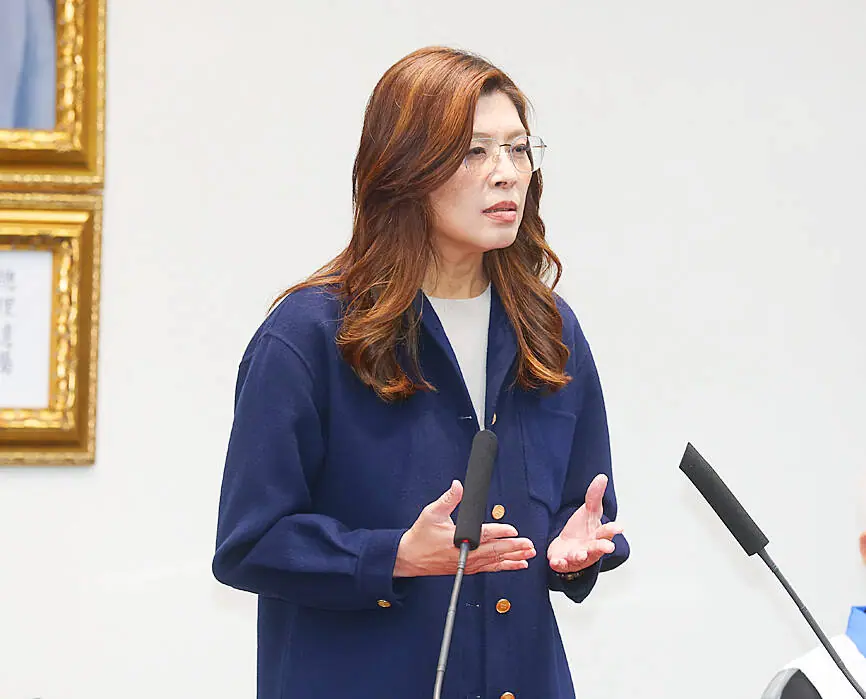
BODY BLOW: KMT Chairwoman Cheng Li-wun canceled a trip to the UK scheduled for this week to patch holes in the hull after many candidates she campaigned for lost
- By Fion Khan / Staff writer, with CNA
The Chinese Nationalist Party’s (KMT) losses in Saturday’s local elections dealt a severe blow to the political prospects and reputation of Taichung Mayor Lu Shiow-yen (盧秀燕) and KMT Chairwoman Cheng Li-wun (鄭麗文), party insiders said.
Despite retaining control in Taipei and New Taipei City, the KMT lost multiple strongholds, including Taichung — one of the six special municipalities — and Chiayi City, as well as the counties of Hsinchu, Changhua, Yunlin and Yilan, reducing the number of administrative regions under its control from 15 in 2022 to 11.
Given the “Ocean Wave” movement generated by Democratic Progressive Party (DPP) Taipei mayoral candidate Puma Shen (沈伯洋), the KMT faced an uphill battle to retain Taipei and New Taipei City, a KMT campaign aide said.
Chinese Nationalist Party (KMT) Chairwoman Cheng Li-wun speaks at a press conference at the KMT headquarters in Taipei on Saturday.Photo: CNA
While the KMT in Taipei and New Taipei City devoted considerable efforts to preventing the momentum from spreading, Taichung bore the brunt of its spillover, they said.
With national attention focused on northern Taiwan, the KMT neglected Taichung and unexpectedly lost the city, bringing the balance of power between the KMT and the DPP across the six special municipalities back to three apiece, they said.
Losing one of the six special municipalities was undoubtedly a major setback for the party, they added.
Lu, who had been regarded within the party as a leading presidential hopeful, had served as campaign manager for Taipei Mayor Chiang Wan-an’s (蔣萬安) campaign headquarters, helping the KMT retain its northern strongholds, they said.
However, losing her home base has cast doubt on her prospects of securing the party’s nomination for the 2028 presidential election, they said.
Meanwhile, Cheng had played a relatively limited role in campaigning for the KMT’s mayoral candidates in the six special municipalities, who kept their distance from her, another party insider said
Cheng instead focused her efforts on areas where the KMT was in power but facing tight races, including Chiayi City, Yilan, Hsinchu and Changhua counties, they said.
The KMT lost control of all four areas in Saturday’s vote, and although each defeat had its own underlying causes, Cheng’s standing would inevitably be affected, the source said.
The losses pushed the KMT’s governing footprint back to Taipei, New Taipei City and Taoyuan, putting the party at a disadvantage in the 2028 presidential election, they said, adding that whether internal blame would fall on Lu or Cheng would be a key issue to watch.
KMT Vice Chairman and Secretary-General Lee Chien-lung (李乾龍) and KMT Organizational Development Committee director Lee Che-hua (李哲華) offered to resign due to poor election performance, people familiar with the matter said yesterday.
Cheng has not made an immediate decision about the resignations, but said the party would convene a review meeting to comprehensively examine the reasons for its defeats across the country, they said.
Local KMT campaign aides said the party’s performance had fallen short of expectations, with party branch chiefs in several counties and cities resigning over the defeats.
It would be unreasonable for no one at the party’s central headquarters to do the same, they said.
While the party is expected to begin reviewing the election results this week, Cheng was scheduled to visit the UK from Wednesday to Sunday.
The trip, overlapping with the time the party is expected to begin reviewing the election results, was seen by some party members as an attempt to avoid calls for her to step down, a party member said.
Sources later yesterday said Cheng canceled her UK trip to shore up support among local factions amid growing pressure to step down.
Miaoli County Commissioner Chung Tung-chin (鍾東錦), who won re-election, said yesterday that the party’s central campaign arrangements had been “somewhat chaotic,” particularly its candidate nomination process, which had been “excessively dominated by individual discretion.”
The party’s central leadership must address the problems and conduct a serious review, he said, urging Cheng to promptly convene senior party officials to discuss strategies ahead of the 2028 presidential election.
In response, KMT Culture and Communications Committee Director Chen Yi-hsin (陳以信) said election setbacks cannot be attributed solely to external factors, and local coordination and party unity would always remain essential tasks that the KMT could not afford to neglect.
The party would listen with an open mind and address the criticism, he said, adding that it must conduct a thorough review, learn from its mistakes and quickly regroup to face upcoming legislative by-elections, speaker elections and the 2028 presidential election as a united party.
Additional reporting by Lin Hsin-han