
INVOLVEMENT WORKS: While Puma Shen’s personal campaign was not a success, the energy he brought to the campaign spread to other DPP races across Taiwan
- By Huang Ching-hsuan, Chen Yu-fu and William Hetherington / Staff reporters, with staff writer and CNA
The effect of Democratic Progressive Party (DPP) Taipei mayoral candidate Puma Shen’s (沈伯洋) “Ocean Wave” campaign helped the party expand its electoral gains in the local elections, analysts said.
In Saturday’s elections, although the Chinese Nationalist Party (KMT) retained control of most of its key governing strongholds in the north, the DPP expanded its presence in central and southern Taiwan.
The DPP won 10 mayoral and county commissioner seats, up from five in 2022, overturning KMT control in Taichung, Chiayi City and Hsinchu, Changhua, Yilan and Yunlin counties.
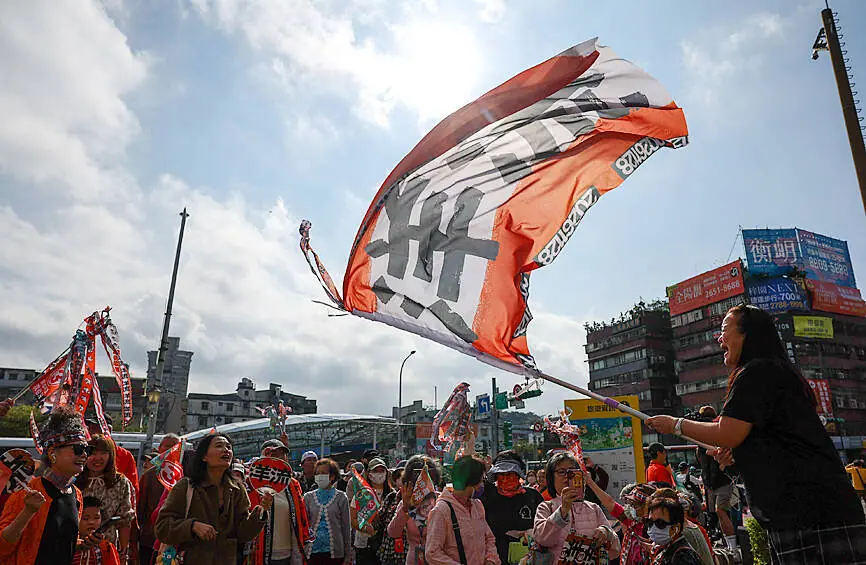
Supporters of Democratic Progressive Party Taipei mayoral candidate Puma Shen wave campaign flags and cheer during a campaign event ahead of Taiwan mayoral election in Taipei on Friday.Photo: AFP
The KMT retained 11 of the 13 seats it won in the previous election, while independent Hsinchu Mayor Ann Kao (高虹安) secured re-election.
National Taiwan University political science associate professor Chen Shih-min (陳世民) said yesterday the DPP’s victory, and the KMT’s weaker-than-expected performance, could be attributed partly to KMT chairwoman Cheng Li-wun’s (鄭麗文) pro-Beijing leanings, which hurt the party’s appeal among centrist voters.
The effect of Shen’s “Ocean Wave” campaign fueled a broader civic movement, he said.
Although Shen failed to win himself, the civic awareness and engagement generated by the movement would continue to build, benefiting Taiwan’s democratic development, Chen said.
Tunghai University political science professor Lin Tzu-li (林子立) said the “Ocean Wave” effect had a polarizing impact in Taipei, prompting supporters of both major parties to return to their respective camps.
The stronger the movement became, the greater the sense of urgency among KMT supporters, who were motivated by fears of defeat, to turn out and defend the party’s position in the capital, Lin said.
National Policy Foundation deputy president Kuo Yu-jen (郭育仁) said Shen had successfully played a sacrificial role, likening him to a candle that burns itself to illuminate others.
The spillover effect of the “Ocean Wave” phenomenon had significantly shaped election outcomes in Keelung, New Taipei City, Hsinchu County and Taichung, he said.
Former United Microelectronics Corp chairman Robert Tsao (曹興誠) said in a social media post that although Shen’s failure to become Taipei mayor was disappointing, generating such a movement in just a short period was itself a remarkable achievement.
Tsao said the movement had dealt Beijing a major blow. By placing Shen on its wanted list and threatening to pursue his arrest internationally, Beijing had sought to intimidate Taiwanese voters. However, the movement demonstrated that China has no jurisdiction over Taiwan and that the Taiwanese would not be deterred by its threats, he said.
The movement represented a spirit of selflessness and sacrifice that should encourage local politicians to embrace public service and put public interest ahead of personal gain, Tsao said.
DPP Legislator Kuo Yu-ching (郭昱晴) said yesterday that the party had fought a successful campaign and achieved strong results.
Shen secured more than 660,000 votes, or 45.69 percent, despite having only 199 days to campaign, she said. The “Ocean Wave” effect mobilized centrist and younger voters across Taiwan, contributing to the DPP’s gains in Taichung and a net increase of 32 seats in local council elections nationwide, she said.
Looking ahead to the 2028 presidential election, the DPP must focus on delivering results in the 10 newly won local governments and maintaining the trust of the additional 1.29 million voters who supported the party, Kuo said.
The central and local governments must work together to demonstrate tangible achievements and sustain the momentum behind the movement, she said.
KMT Tainan mayoral candidate Hsieh Lung-chieh (謝龍介), who conceded defeat Saturday evening, acknowledged yesterday that the “Ocean Wave” effect had contributed to the party’s loss of the Taichung mayoralty.
KMT vice chairman and secretary-general Lee Chien-lung (李乾龍) said yesterday that he believed the “Ocean Wave” movement was built with money and amplified by media outlets under its influence.
Lee attributed the KMT’s wins in Taipei and New Taipei City to overconfidence and complacency among the DPP candidates.
Additional reporting by Lin Che-yuan, Lo Kuo-chia and Wang Chun-chung